Have you ever come across a job description that feels like it was written just for you? That’s exactly the feeling this one gave me. Let me walk you through why this Software Engineering Specialist role at GE Vernova might be the career move you’ve been waiting for.
About GE Vernova
This isn’t your typical tech company.
GE Vernova is the energy arm of GE—focused solely on powering the world. But here’s what sets them apart:
Purpose over hype. Your code helps build a smarter, cleaner grid. It’s real impact.
Small teams, big reach. Agile culture with the resources of a global giant.
They respect craftsmanship. Clean code, security, testing—it’s baked into how they work.
It’s not just a job. It’s building something that actually matters.
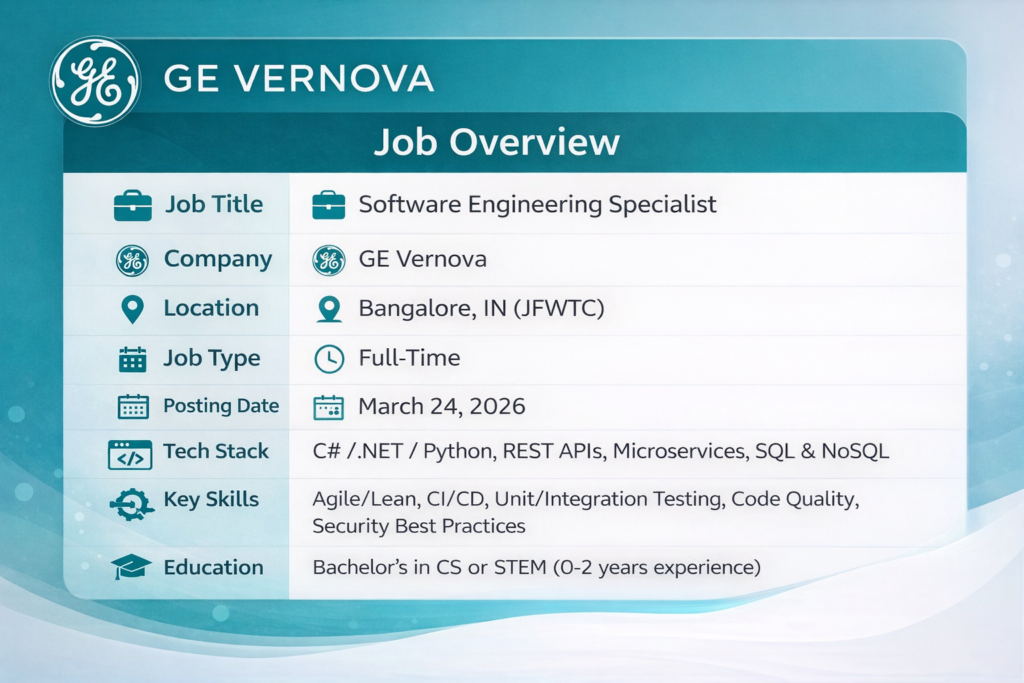
Bachelor’s degree in Computer Science or any STEM field (Science, Technology, Engineering, Math)
Experience
0 to 2 years—yes, freshers and early-career developers are welcome
Location
Bangalore, India
Skills You’ll Bring
Skill
What It Really Means
C# / .NET / Python
You’ve built real things, not just studied them.
REST APIs
You make apps talk smoothly.
SQL & NoSQL
You handle data your way—structured or flexible.
Microservices
You keep services independent yet connected.
Agile & CI/CD
You ship often, ship safe.
Testing & Quality
Your code won’t need an apology.
Security Basics
You code like someone’s watching.
Roles & Responsibilities of Software Engineer at GE Vernova
GE Vernova – Before vs After | Software Engineering Specialist
✨ Before Joining vs After Joining ✨
Same skills. Different meaning. Here’s how this role changes your story.
⏳ Before Joining
💻 C# / .NET / Python
“I’ve written code that works — mostly.”
🔌 REST APIs
“I know how to connect two apps without breaking them.”
🗃️ SQL & NoSQL
“Data lives somewhere. I can find it and use it.”
🧩 Microservices
“Small services. Big picture? Still connecting the dots.”
🔄 Agile & CI/CD
“I’ve heard of sprints and pipelines. Ready to live them.”
🧪 Testing & Code Quality
“I write tests when I remember. Sometimes.”
🛡️ Security & Error Handling
“I try not to break things. Security? I’m learning.”
🚀 After Joining GE Vernova
⚡ C# / .NET / Python
“I build scalable, production-grade code that powers real energy infrastructure.”
🌐 REST APIs
“I design resilient APIs that connect global systems seamlessly.”
📊 SQL & NoSQL
“I architect data solutions — structured or unstructured — with confidence.”
🏗️ Microservices
“I build and orchestrate microservices that talk, scale, and stay reliable.”
⚙️ Agile & CI/CD
“I own the pipeline — from commit to deployment, fast and safe.”
✅ Testing & Code Quality
“I write clean, tested, maintainable code. Quality is my signature.”
🔐 Security & Error Handling
“I build with security first — because reliable systems don’t break at 3 AM.”
🌟 Based on GE Vernova’s Software Engineering Specialist role — same requirements, transformed perspective.
GE Vernova Hiring Process for Freshers 2026
GE Vernova – Your Hiring Roadmap
🚩 Your Hiring Roadmap
Every flag marks a milestone — from apply to offer
📄
STEP 1
Online Application
Submit your resume via GE Vernova careers portal. STEM degree + 0–2 years.
✨ Tailor to C#/.NET/Python & projects
🔍
STEP 2
Resume Screening
HR shortlists based on eligibility and relevant skills.
⏱️ 1–2 weeks wait
📝
STEP 3
Online Assessment
Aptitude + coding fundamentals (DSA, SQL, logic).
🧠 Arrays, loops, palindromes
💻
STEP 4
Technical Interviews
1–2 rounds: OOP, data structures, projects, SQL.
⚙️ Explain your code & approach
🤝
STEP 5
HR Interview
Motivation, culture fit, salary discussion.
🗣️ “Why GE Vernova?”
🎉
STEP 6
Offer & Background
Offer letter followed by background verification.
✅ You’re in!
⚡ Based on public candidate experiences and standard GE Vernova early‑career hiring practices. Steps may vary slightly.
GE Vernova – Advanced Interview Questions
🔥 Not Your Average Interview Prep
🎯 Questions That Separate the Curious from the Rest
These aren’t textbook questions. They’re real-world scenarios GE Vernova engineers actually face.
1🔥 HardYour REST API endpoint suddenly takes 8 seconds to respond. It was taking 200ms yesterday. No code was deployed. Walk me through your debugging process — from first step to root cause.
▼
Real-world debugging approach:
Check logs first — look for error spikes, slow query logs, or timeout exceptions.
Check database — run SHOW PROCESSLIST (MySQL) or check for locks, long-running queries, missing indexes.
Check external dependencies — is a downstream service or third-party API slow?
Check recent traffic patterns — sudden spike in requests? DDOS or unexpected load?
💡 What they’re looking for: This question tests systematic thinking. Do you jump to code first, or do you methodically examine logs, databases, and infrastructure? The interviewer wants to see your debugging discipline, not a lucky guess.
🎯 Follow-up they often ask: “What if the database query is the problem but you can’t change the query — what do you do?” (Answer: Add index, caching, or read replica)
2🧠 ExpertYou have 5 microservices. Service A calls Service B. Service B is down. How does your system behave? Walk me through circuit breakers, retries, and fallbacks — in code or design.
▼
Resilience patterns they expect you to know:
// Circuit Breaker pattern (C# – Polly library example)
retryPolicy.Wrap(circuitBreaker).Execute(() => {
return serviceBClient.GetData();
});
// Fallback
var result = policy.ExecuteAndCapture(() => serviceBClient.GetData());
if (result.Outcome == OutcomeType.Failure) {
return cachedData; // or default response
}
Key concepts:
Circuit Breaker: After X failures, stop calling — let service recover
Retry with backoff: Exponential backoff, not immediate retries
Timeout: Don’t wait forever — fail fast
Fallback: Cache, default response, or graceful degradation
💡 Why this is unique: Most freshers memorize “microservices are independent” but rarely understand failure handling. GE Vernova deals with energy infrastructure — if one service fails, the grid shouldn’t crash. With this question, interviewers assess whether you think about resilience from the start.
3⚡ MediumDesign a database schema for tracking energy meters across 10,000 locations. Each meter sends 1 reading every 5 minutes. How do you store this? SQL or NoSQL? Show me your table design and explain your choice.
▼
Data volume: 10,000 meters × 12 readings/hour × 24 hours = 2.88 million readings/day. ~1 billion readings/year.
Recommended approach: Time-series database or NoSQL (TimescaleDB, InfluxDB, or Cassandra)
— If using SQL (with partitioning):
CREATE TABLE meter_readings (
id BIGSERIAL,
meter_id INT NOT NULL,
reading_value DECIMAL(10,2),
reading_timestamp TIMESTAMPTZ NOT NULL,
PRIMARY KEY (meter_id, reading_timestamp)
) PARTITION BY RANGE (reading_timestamp);
— Create monthly partitions
— Index on (meter_id, reading_timestamp) for fast queries
Why not pure SQL without partitioning? Table becomes huge → slow queries, expensive maintenance.
💡 What makes this unique: This question goes beyond textbook schemas. It tests whether you understand scale. Anyone can design a Users table. Here, you need to design for billions of records — exactly what GE Vernova encounters with IoT data from energy equipment.
🎯 Follow-up: “How would you query the average reading for a meter over the last 24 hours efficiently?”
4🔒 HardYour API accepts user input and runs a SQL query. What could go wrong? Show me vulnerable code first, then fix it. What other security risks should you check in a REST API?
▼
Vulnerable code (SQL Injection):
// DANGEROUS — NEVER DO THIS
string query = “SELECT * FROM Users WHERE name = ‘” + userInput + “‘”;
var data = db.ExecuteQuery(query);
Fixed version (Parameterized Query):
// SAFE — using parameters
string query = “SELECT * FROM Users WHERE name = @name”;
var data = db.ExecuteQuery(query, new { name = userInput });
Other REST API security risks:
Authentication missing — anyone can call the API
No rate limiting — brute force attacks
Exposing internal error details — never show stack traces to client
Mass assignment — user sends extra fields you didn’t expect
No HTTPS — credentials sent in plain text
⚠️ Why this is rarely asked to freshers: Security is often ignored for junior roles, but GE Vernova works with critical infrastructure. A breach here isn’t just data loss — it could affect power grids. That’s why even early-career candidates are expected to think security‑first.
5🎯 ExpertOOP is everywhere. But tell me — when would you NOT use OOP? Give me a real scenario where functional or procedural programming is a better choice, and explain why.
▼
Scenarios where OOP is NOT ideal:
Data transformation pipelines — functional programming (map/filter/reduce) is cleaner and more readable
Performance-critical systems — virtual method calls have overhead; procedural can be faster
Stateless processing — if there’s no state to manage, objects add little value
Example: Processing sensor data stream
// OOP way — overkill
class SensorProcessor {
public List FilterOutliers(List data) { … }
public double CalculateAverage(List data) { … }
}
// Functional way — cleaner (Python)
def process_sensor_data(readings):
filtered = [r for r in readings if is_valid(r)]
avg = sum(filtered) / len(filtered)
return avg
💡 Why this is a killer question: Anyone can explain polymorphism. But knowing when not to use OOP shows true engineering maturity. You don’t force patterns — you choose the right tool for the job. This impresses senior interviewers.
🎯 Follow-up: “So in the microservices we discussed earlier — would you use OOP inside each service? Why or why not?”
🎯 These questions are based on real GE Vernova technical interviews — focusing on system thinking, resilience, scale, security, and engineering judgment.
Salary & Benefits for Freshers in Bangalore
What’s in It for You?
Category
Details
Estimated Salary
₹6 – ₹9 LPA (depending on skills, interview performance, and prior experience)
Performance Bonus
Annual variable pay — usually a percentage of your salary, tied to individual and company goals
Health & Wellness
Comprehensive medical insurance for you and your family, plus wellness programs
Learning & Growth
Access to technical certifications, internal learning platforms, and mentorship programs
Work Flexibility
Hybrid work model (mix of office and remote) — role is based in Bangalore
Leave Policy
Generous paid time off, plus public holidays and sick leave
Additional Perks
Relocation assistance (if applicable), employee assistance programs, and occasional team events
5 Mistakes to Avoid When Applying for GE Vernova Jobs
Generic resume → Tailor it to C#, .NET, Python, REST APIs, microservices. Show projects using these skills.
Underestimating the “0–2 years” sweet spot → Be honest. Freshers: highlight internships and academic projects. Experienced: show real-world application.
Weak “Why GE Vernova?” answer → Mention their energy mission or the GE spin‑off. Prove you’ve done your research.
Skipping online assessment prep → Practice basic DSA (arrays, sorting), SQL joins, and logical reasoning. Don’t let the test catch you off guard.
Saying “no” when asked for questions → Ask something meaningful—like how the team handles microservices or ensures code quality. It shows genuine interest.
FAQs – GE Vernova Software Engineer Fresher Role
❓ Do I need work experience? No. 0–2 years is the sweet spot. Freshers with strong projects are welcome.
❓ What programming languages should I know? C#, .NET, or Python. Bonus if you’ve built REST APIs or worked with databases.
❓ Is there a coding test? Yes. Online assessment covers basic DSA, SQL, and logical reasoning. Practice beforehand.
❓ Will I be trained? Absolutely. Mentorship, learning platforms, and on-the-job guidance are part of the package.
❓ What makes GE Vernova different? They build software that powers real energy infrastructure—your code will have actual impact.