
NVIDIA N.Ex.T Freshers Hiring :
If you think your understanding of digital design, analytical reasoning, and C++ is sharp enough to impress the company that redefined parallel computing, NVIDIA just threw down the gauntlet—and it’s called N.Ex.T 2026.
About NVIDIA and N.Ex.T 2026 Program
NVIDIA isn’t just a company that makes graphics cards. It’s the engine behind the AI revolution, the architect of parallel computing, and the force that turned gaming GPUs into the brains of data centers, autonomous vehicles, and scientific breakthroughs. For engineers, working at NVIDIA means building hardware that defines what’s possible—from the smallest embedded system to the world’s largest supercomputers.
N.Ex.T (NVIDIA Exceptional Talent) is the company’s way of discovering India’s most promising hardware engineering graduates—no campus visits, no cold emails, just a clean, merit-based path. Now in its fourth edition, the program distills a high‑stakes recruitment process into two HackerRank tests and two rounds of technical conversations. Clear them, and you step directly into a full‑time hardware engineering role at NVIDIA Bangalore, joining a team that builds the silicon powering the next decade of AI.
No fluff. Just a direct shot at one of the most impactful engineering careers you can start in 2026.
NVIDIA N.Ex.T 2026 Job Overview for Freshers (India)
NVIDIA- N.Ex.T 2026 isn’t just a hiring drive—it’s a direct launchpad for India’s brightest hardware engineering graduates to build the silicon that powers the age of AI.
NVIDIA N.Ex.T 2026 Eligibility & Skills Required for Freshers
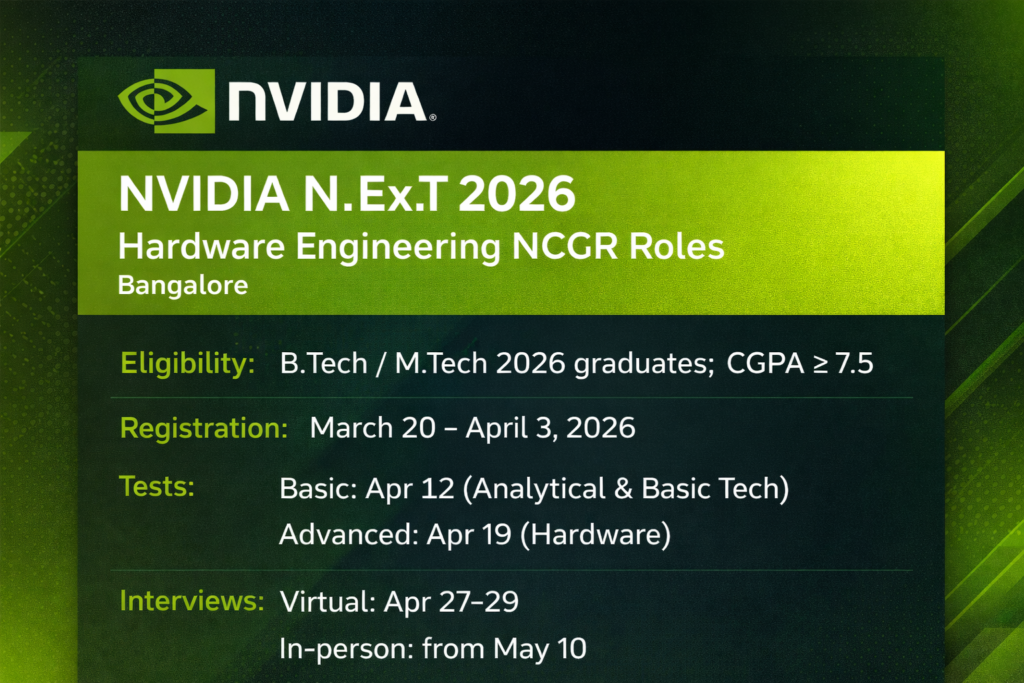
| 🔍 Category | ⚙️ Requirement | 📝 Details / Notes |
|---|---|---|
| 🎓 Academic Eligibility | Degree & Year | B.Tech / M.Tech – graduating in 2026 |
| Minimum CGPA | 7.5 or above (no rounding; strictly enforced) | |
| Field of Study | Engineering in relevant disciplines (ECE, EE, CS, etc.) | |
| 🧠 Core Skills | Problem Solving | Strong analytical & quantitative reasoning |
| Technical Foundation | Basic electronics, digital design, computer architecture (aligned to Hardware Engineering) | |
| Programming | C/C++ fundamentals – often used in hardware validation and test | |
| 🚀 Mindset & Attributes | Passion for Technology | Demonstrated interest in semiconductors, GPUs, or cutting-edge hardware |
| Innovation Drive | Ability to think beyond textbook solutions | |
| Collaboration | Team-first attitude (critical for hardware development cycles) | |
| 📋 Process Fit | Test Readiness | Must clear both HackerRank tests (Basic + Advanced) |
| Availability | Full day for virtual (Apr 27–29) and in‑person (from May 10) interviews |
Hardware Engineering Roles & Responsibilities at NVIDIA
🔧 Hardware Engineering @ NVIDIA
N.Ex.T 2026 — full‑time roles for graduates who want to build the future of AI & accelerated computing
ASIC Design
RTL, micro‑architecture, low‑power logic — shape the silicon itself.
Design Verification
UVM, testbench automation, coverage — guarantee first‑pass silicon.
Physical Design
Synthesis, P&R, STA — push performance on advanced nodes (3nm/5nm).
GPU/AI Architecture
Define next‑gen cores, memory subsystems, and AI accelerators.
- ▹ Design & implement RTL (Verilog/SystemVerilog) for high‑performance IP blocks
- ▹ Build UVM environments and run verification at IP, subsystem, and SoC levels
- ▹ Drive timing closure, power optimization, and physical implementation
- ▹ Collaborate with architects to define micro‑architecture for AI/GPU cores
- ▹ Debug complex pre‑silicon issues using simulation, emulation, and formal tools
- ▹ Work across teams — from DFT to post‑silicon — to ensure flawless tape‑out
NVIDIA N.Ex.T 2026 Hiring Process
📋 N.Ex.T 2026 – Hiring Process
Two tests + two rounds of discussions — a clear, merit‑based path to NVIDIA’s Hardware Engineering team.
📝 Registration
🧠 N.Ex.T Basic Test
⚙️ N.Ex.T Advanced Test
💻 Technical Interviews – Round I (Virtual)
🏢 Technical Interviews – Round II (In‑Person)
NVIDIA Freshers Salary 2026 (N.Ex.T Program Benefits & Perks)
| 💎 Benefit | 🎯 What You Get |
|---|---|
| 💰 Salary | Competitive base (₹18–25 LPA) + performance bonus |
| 📦 Stock | Restricted Stock Units (RSUs) – own a piece of NVIDIA |
| 🏥 Health | Medical coverage for self & family + wellness perks |
| 🍽️ Campus | Premium cafeteria, shuttles, recreation zones (Bangalore) |
| 🚀 Growth | Work on real GPU/ASIC hardware, mentored by industry experts |
NVIDIA N.Ex.T 2026 Hardware Interview Questions
🎯 Hardware Interview Questions
What NVIDIA asks in N.Ex.T 2026 – real design scenarios, not just textbook definitions
- ▹ Sketch a 4‑bit synchronous counter with enable and reset. Modify it to count only odd numbers.
- ▹ Write a Verilog module for a simple FIFO. How do you handle full/empty flags? What happens on simultaneous read/write?
- ▹ What’s metastability? How do you fix it in a cross‑clock domain crossing? Draw the synchronizer circuit.
- ▹ Design a finite state machine for a traffic light controller. Show state diagram and RTL.
- ▹ Draw a basic 5‑stage pipeline. Identify hazards and show how data forwarding works.
- ▹ Explain cache coherence in multi‑core systems. Difference between MESI and MOESI?
- ▹ How does a branch predictor work? Give an example of a 2‑bit saturating counter.
- ▹ You have an 8‑bit adder. Design a 16‑bit adder using two of them. What’s the critical path?
- ▹ What’s the difference between a traditional testbench and a UVM environment?
- ▹ How do you achieve 100% code coverage? Is it always necessary?
- ▹ You find a bug in RTL after tape‑out. How would you debug it? (Pre‑silicon vs. post‑silicon)
- ▹ How would you verify a simple ALU? List all test scenarios you’d write.
- ▹ What are setup and hold time? Draw a timing diagram showing a violation and how to fix it.
- ▹ Explain synthesis vs. place‑and‑route. What files are generated at each step?
- ▹ How do you reduce dynamic power in a chip? Name three techniques.
- ▹ What is clock tree synthesis (CTS) and why is it important?
- ▹ Tell me about a time you debugged a tough hardware issue. What was your approach?
- ▹ What hardware project are you most proud of? (Be ready to share block diagrams or code.)
- ▹ Why hardware over software? (Be specific: mention NVIDIA’s impact in AI, autonomous machines, or GPUs.)
- ▹ You’re given an ambiguous design spec. How do you proceed?
Top 5 Mistakes to Avoid in NVIDIA N.Ex.T 2026 Application
- Applying below 7.5 CGPA – Auto‑filtered. No exceptions.
- Ignoring hardware in the Basic Test – It’s not just aptitude; digital logic & C fundamentals matter.
- Underestimating the Advanced Test – Deep hardware focus (arch, RTL, verification). Don’t coast after round one.
- Memorizing definitions without design reasoning – Interviews test scenarios (pipeline, FIFO, timing), not just theory.
- Giving a vague “why NVIDIA” answer – Say something specific: “I want to build silicon for AI accelerators like Blackwell.”
NVIDIA N.Ex.T 2026 FAQs
1. Can I apply if my CGPA is exactly 7.5?
Yes. The cutoff is 7.5 and above — that includes 7.5.
2. I’m from a non‑CSE branch (ECE, EE, etc.). Am I eligible?
Absolutely. Hardware roles welcome Electronics, Electrical, and related branches. In fact, they’re often preferred over CSE.
3. Will my application be rejected if I don’t have prior VLSI internships?
No. N.Ex.T is designed for fresh graduates. Internships help but are not mandatory. Strong fundamentals matter more.
4. What language are the tests in?
Both HackerRank tests are in English.
5. I missed the Basic Test. Can I request a re‑test?
No. The schedule is fixed — no re‑tests or make‑up slots.
How to Apply for NVIDIA N.Ex.T 2026
Final Pro Tip – From NVIDIA Insiders
NVIDIA’s hardware interviews often throw real design scenarios at you, not textbook questions. Before the tests, spend 30 minutes sketching a tiny CPU pipeline or debugging a Verilog snippet on paper. If you can explain why a signal races or a FIFO overflows, you’re already ahead of 90% of applicants.”
“I want to build the silicon that makes AI fast enough to feel like magic.”
That’s the NVIDIA mindset.