
The Kong Software Engineering Internship 2026 application window has ended. But if you already applied — or want to prepare for future roles — the interview questions, process insights, and pro tips below will give you a huge edge.
Kong Internship India 2026 :

If you’re a third-year computer science student already dreaming about summer 2026, here’s an opportunity that might just shape your entire career—and it comes with mentorship, real-world projects, and a chance to ship code that powers the world’s APIs.
About Kong Inc. and Its API Platform

Ever wonder how apps like Netflix or your banking app talk to each other? That’s APIs at work. Kong is the company that helps power those connections—securely, reliably, and at scale.
Started by two friends in Italy, Kong now serves Fortune 500 companies across finance, airlines, and e-commerce. Their open-source API gateway became the #1 API project on GitHub.
Simply put, Kong is the invisible engine behind the digital world you use every day.
Kong Internship 2026 Bangalore: Full Overview
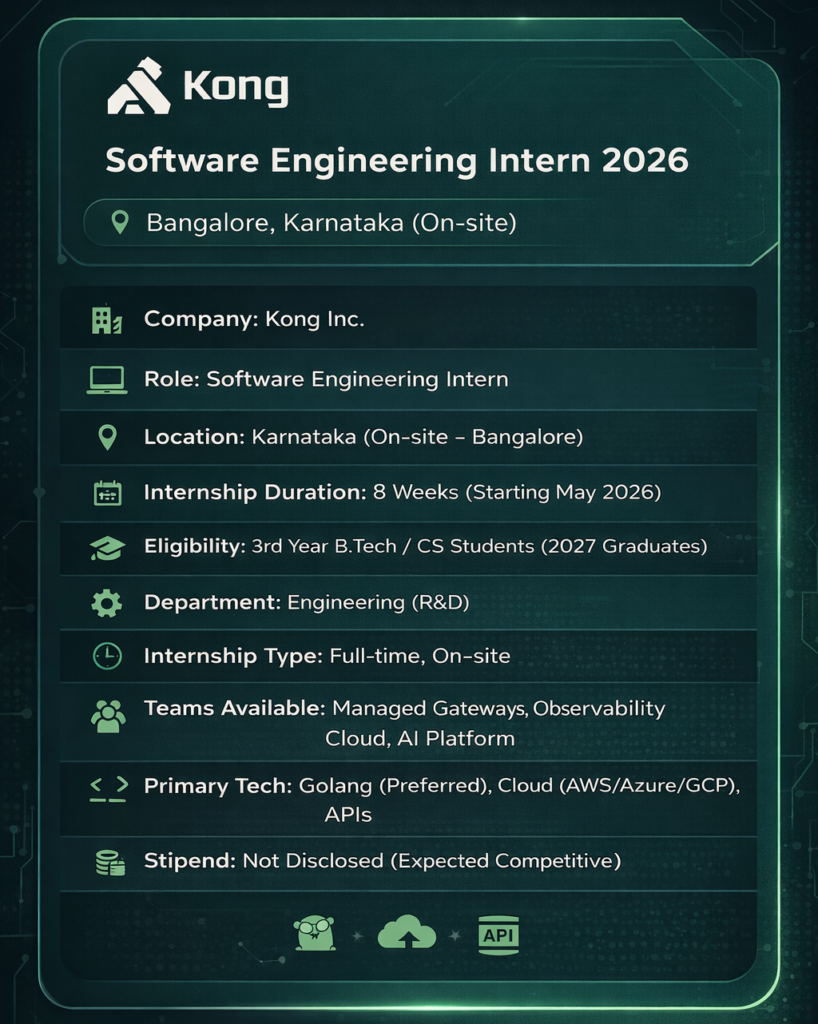
Kong Internship 2026 Eligibility and Skills Required
Before you start dreaming about shipping code to production, let’s quickly check if you’re the kind of candidate Kong is looking for. Spoiler alert—you don’t need to check every box.
Eligibility Criteria
| Criteria | Details |
|---|---|
| Education | Third-year Bachelor’s student (2027 graduate) |
| Field | Computer Science or related discipline |
| Program Duration | 8 weeks (Starting May 2026) |
| Location | Bangalore, India (On-site) |
Skills Required
| Skill Area | Details |
|---|---|
| Programming | Strong skills in at least one language (Golang highly preferred) |
| Core Concepts | Familiarity with data structures and algorithms |
| Cloud Platforms | Experience with AWS, Azure, or GCP (plus point) |
| Soft Skills | Strong verbal and written communication |
Roles and Responsibilities of Kong SDE Intern
⚡ 8 weeks · real code · real impact
Roles & Responsibilities — Kong SDE Intern
✨ No coffee runs, no busywork. You’ll own a feature, get 1:1 mentorship, and ship to production — just like a full-time engineer.
🧠 Understand & Define
Grasp real customer problems from Kong’s Managed Gateways, Observability or AI teams. Collaborate with mentor to shape scope.
📐 Design the solution
Write a technical design doc — decide how your feature will scale across cloud gateways (AWS/Azure/GCP) or SaaS platform.
⚙️ Build & Iterate
Write production-grade code (Golang preferred). Write tests, handle reviews, and integrate with cloud-native infrastructure.
🚀 Ship to Production
Deploy your code to real Kong environments, monitor performance, and celebrate your first production impact.
Kong Internship 2026 Hiring Process Explained
🚀 Kong Internship 2026 · Hiring Flow
5 steps · one glance
Kong Internship Salary, Perks and Benefits 2026
Salary & Stipend
| Component | Details |
|---|---|
| Stipend | ₹50,000 – ₹80,000 / month |
| Duration | 8 weeks (May – July 2026) |
Perks & Benefits
| Category | Benefit |
|---|---|
| 🏠 Stay | Housing support / relocation assistance |
| 🍽️ Food | Daily meals + unlimited snacks |
| 💻 Gear | Company laptop provided |
| 🚗 Travel | Cab facility / reimbursement |
| 📖 Learning | 1:1 mentorship + Kong University |
| 🚀 Career | Full-time conversion opportunity |
| 🎁 Extras | Welcome kit + intern events |
Kong SDE Intern 2026 Interview Questions
Context: Kong’s API gateway needs to enforce rate limits across multiple clients. Write a rate limiter that allows at most N requests per second per client ID, and works in a concurrent environment.
package main

import (
    "sync"
    "time"
)

type RateLimiter struct {
    mu      sync.Mutex
    limits  map[string][]time.Time
    maxReqs int
    window  time.Duration
}

func NewRateLimiter(maxReqs int, window time.Duration) *RateLimiter {
    return &RateLimiter{
        limits:  make(map[string][]time.Time),
        maxReqs: maxReqs,
        window:  window,
    }
}

func (rl *RateLimiter) Allow(clientID string) bool {
    rl.mu.Lock()
    defer rl.mu.Unlock()

    now := time.Now()
    timestamps := rl.limits[clientID]

    // Remove timestamps older than the window
    cutoff := now.Add(-rl.window)
    valid := []time.Time{}
    for _, t := range timestamps {
        if t.After(cutoff) {
            valid = append(valid, t)
        }
    }

    if len(valid) < rl.maxReqs {
        valid = append(valid, now)
        rl.limits[clientID] = valid
        return true
    }
    return false
}
Explanation: Use a mutex to protect the map. Store timestamps of successful requests and prune the slice on every call. Alternative: token bucket with atomic operations for better performance.
Context: Kong is an API gateway. Describe the high‑level architecture of a minimal gateway that routes requests to backend services and validates an API key.
Key components: Configuration store (routes, services), proxy layer (HTTP reverse proxy), plugin mechanism for authentication, rate limiting, logging. Explain how you’d handle concurrency, timeouts, and hot reloading.
// Pseudo design:
 1. Read config (routes: host/path -> upstream)
 2. HTTP server with middleware chain:
    - Authentication (check API key in header)
    - Rate limiting
    - Proxy forward (http.ReverseProxy)
 3. Use context for cancellation and timeouts
 4. Use goroutines per request (Go’s net/http does that)
Explanation: Emphasize separation of concerns, concurrency safety, and how to integrate with cloud services (e.g., using service discovery).
Problem: Given a string, find the length of the longest substring without repeating characters.
func lengthOfLongestSubstring(s string) int {
    lastPos := make(map[byte]int)
    start, maxLen := 0, 0
    for i := 0; i < len(s); i++ {
        if pos, ok := lastPos[s[i]]; ok && pos >= start {
            start = pos + 1
        }
        lastPos[s[i]] = i
        if i-start+1 > maxLen {
            maxLen = i - start + 1
        }
    }
    return maxLen
}
Explanation: Sliding window with a map to store the last index of each character. O(n) time.
Question: Explain the difference, and where Kong (API gateway) fits.
Forward proxy: Sits between client and internet, used for anonymity, caching, or bypassing restrictions. Reverse proxy: Sits between internet and backend servers, used for load balancing, security, SSL termination. Kong acts as a reverse proxy (with added features like authentication, transformation, analytics).
Also mention that Kong can be deployed as a sidecar (service mesh) or as a central gateway.
System design: High‑level design for a URL shortener. Focus on API endpoints, database schema, hashing, and scalability.
GET /abc123 → 301 redirect to the original URL.
Key points: Use base62 encoding of a unique ID; store mapping in a distributed DB (Cassandra, PostgreSQL with sharding). Cache popular keys with Redis. Discuss 301 vs 302.
func encode(id int64) string {
    const charset = "abcdefghijklmnopqrstuvwxyzABCDEFGHIJKLMNOPQRSTUVWXYZ0123456789"
    base := int64(len(charset))
    var result []byte
    for id > 0 {
        result = append([]byte{charset[id%base]}, result...)
        id /= base
    }
    return string(result)
}Problem: Write a function that fetches data from 10 URLs concurrently, returns the first successful response (with a 2‑second timeout), and cancels the rest.
func fetchFirst(ctx context.Context, urls []string) (string, error) {
    ctx, cancel := context.WithCancel(ctx)
    defer cancel()

    ch := make(chan string, 1)

    for _, url := range urls {
        go func(u string) {
            req, _ := http.NewRequestWithContext(ctx, "GET", u, nil)
            resp, err := http.DefaultClient.Do(req)
            if err != nil {
                return
            }
            defer resp.Body.Close()
            body, _ := io.ReadAll(resp.Body)
            select {
            case ch <- string(body):
            default:
            }
        }(url)
    }

    select {
    case res := <-ch:
        return res, nil
    case <-time.After(2 * time.Second):
        return "", errors.New("timeout")
    }
}
Explanation: Use context cancellation to stop pending goroutines. A buffered channel ensures we don’t block on the first result.
Question: A service suddenly shows high latency. How would you approach debugging in a cloud‑native environment (Kubernetes + Kong)?
Answer: Check metrics (Prometheus): latency percentiles, error rate, CPU/memory. Inspect logs, distributed tracing (Jaeger). Verify database slow queries, network latency between services, and Kong gateway metrics. Use flame graphs to find bottlenecks. Mention chaos engineering or load testing.
Also check if the upstream service is throttling or if a new deployment caused a regression.
Problem: Given k sorted linked lists, merge them into one sorted list.
type ListNode struct {
    Val  int
    Next *ListNode
}

func mergeKLists(lists []*ListNode) *ListNode {
    if len(lists) == 0 { return nil }
    h := &minHeap{}
    heap.Init(h)
    for _, head := range lists {
        if head != nil {
            heap.Push(h, head)
        }
    }
    dummy := &ListNode{}
    tail := dummy
    for h.Len() > 0 {
        node := heap.Pop(h).(*ListNode)
        tail.Next = node
        tail = tail.Next
        if node.Next != nil {
            heap.Push(h, node.Next)
        }
    }
    return dummy.Next
}
Explanation: Use a min‑heap (priority queue) of size k. Pop smallest, push its next, O(N log k).
Context: Kong's plugin system allows custom logic (authentication, transformation, logging). Explain the concept of access, response, and log phases, and how order matters.
Answer: Plugins run in a chain. Each plugin can hook into different phases: certificate, rewrite, access, response, log. The order is configurable via priorities (higher numbers run first). In the access phase, a plugin can short‑circuit the request (e.g., reject with 401). Understanding this is key to building efficient gateways.
Also mention that custom plugins are written in Lua (or Go using PDK) and are executed in a sandboxed environment.
Problem: You need to count total API requests across millions of clients in a distributed system. How would you implement an eventually‑consistent counter?
Answer: Use a partitioned counter in Redis (sharded) with atomic increments, or use a streaming approach (Kafka) + batch updates to a database. Another approach: use a local counter in each gateway instance and flush periodically to a central store. Discuss trade‑offs between accuracy and scalability. Mention CRDTs if strong eventual consistency is needed.
// Example: sharded Redis increment
func increment(prefix, key string) {
    shard := hash(key) % numShards
    redisClient[shard].Incr(prefix + ":" + key)
}
Explanation: High‑volume counters need to avoid contention. Sharding reduces single‑key bottlenecks.
Top 5 Mistakes to Avoid in Kong Internship Application
❌ 1. Generic Resume
Kong wants Golang & cloud skills. Show them. Don't send the same resume everywhere.
❌ 2. Self-Rejecting
The JD literally says "nobody checks every box." Apply anyway. Curiosity > perfection.
❌ 3. No Proof of Coding
Saying "familiar with Golang" means nothing. Share GitHub. Show real code.
❌ 4. Poor Communication
Sloppy writing = sloppy thinking. Your application and interviews are being judged on clarity.
❌ 5. Tech-Only Focus
Kong powers Fortune 500 APIs. Show impact, not just tools. "Built X that improved Y" > "Used Z."
Kong Internship 2026 FAQs
1. Do I need to know Golang to apply?
No, but it's your biggest advantage. Kong's codebase runs on Go. If you know Python, Java, or C++, show you can pick up Golang fast. Side projects speak louder than words.
2. Is this internship remote or on-site?
On-site. Bangalore office. Why? Because mentorship happens best in person. You'll sit next to senior engineers, pair program, and build relationships that last.
3. Will I get a full-time offer after internship?
If you ship great code and fit the culture — yes. Kong uses internships as their primary pipeline for full-time hires. Perform well, and the door stays open.
4. What if I have no cloud experience?
Learn the basics before applying. AWS, Azure, or GCP — pick one. Even a free-tier project (like deploying a simple API) shows initiative. Kong values self-starters.
5. How competitive is the selection process?
Very. But here's the secret: Kong cares more about curiosity, ownership, and clean code than perfect grades. Stand out by showing you build things, not just study for exams.
How to Apply for Kong Internship 2026
🔥 The Insider's Edge
what most candidates miss
Kong’s runtime powers real APIs. They hire builders. A deployed side project (even a tiny API gateway) screams "I ship code" louder than any grade.
Spin up a free AWS/Azure/GCP instance. Deploy a simple Go service. Mention it — it proves you can navigate the exact tools Kong uses daily.
Read Kong’s blog or the open-source gateway docs. Reference them in your interview. Engineers notice when you've done your homework.
“Nobody checks every box — so stop self‑rejecting. The only guaranteed way to miss this opportunity is to not apply.”