
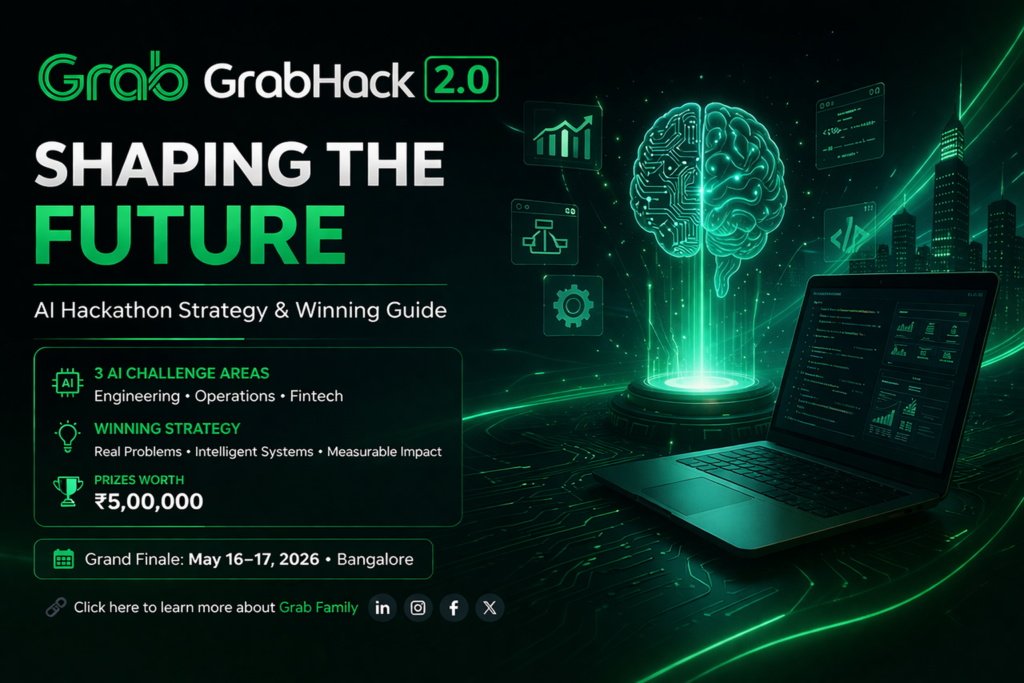
Beyond Demos, Toward Decision Intelligence
🚀 Why This Hackathon Actually Matters
Most hackathons reward velocity over value — but GrabHack 2.0 inverts the equation. It’s not about speed alone. It’s about architecting intelligent systems that solve real business frictions using AI. The shift from quick demos to production-ready thinking is what separates legacy entries from breakthrough solutions.
🧠 What Makes GrabHack 2.0 Different?
Unlike typical hackathons, this one focuses on three high-leverage domains:
- 🤖 AI-powered engineering productivity — tools that make developers faster and reduce toil
- 📊 Intelligent business operations — automation beyond chatbots, driving operational excellence
- 💰 Fintech solutions for real users — inclusive, secure, and impactful financial tools
⚠️ The Problem With Most Hackathon Approaches
Here’s the uncomfortable truth: Most participants will fail — not because they lack skills, but because they approach it wrong. They build UI-heavy demos, overuse AI buzzwords, and skip real problem validation. This leads to weak presentations, no clear impact, and forgettable solutions.
🚫 Mistake 1: AI as a Feature, Not a System
Real intelligence structures data flow and outputs meaningful decisions.
🚫 Mistake 2: Ignoring Real Impact
Judges love numbers: time saved, cost reduced, efficiency improved.
🚫 Mistake 3: Weak Problem Definition
Define constraints, user persona, and frequency of the pain point.
🚫 Mistake 4: Overengineering the Solution
A sharp, narrow AI solution beats an unfinished platform.
💡 A Strong AI Project Direction (Example)
🧠 AI-Powered Incident Intelligence System
Problem: Developers struggle to identify root causes during production failures — average MTTR is high, causing business impact.
Solution: An AI system that analyzes logs + error traces, detects anomaly patterns, suggests probable root causes, and recommends fixes.
Impact: Faster debugging, reduced downtime, improved developer productivity (measurable: 40% reduction in mean time to resolution).
Projects like this win because they show clear business value + AI does meaningful reasoning, not just classification.
⚙️ How to Structure Your Hackathon Solution
To stand out, your submission should articulate each layer:
- 1. Problem Clarity – Specific user pain, frequency, current cost of inaction.
- 2. AI Logic – What data, which model/approach, how processing generates insights.
- 3. System Design – Input layer (data ingestion) → processing (AI/ML core) → output layer (actionable UI/API).
- 4. Business Value – Always answer: why should anyone use this? ROI, adoption, scale.
[ Telemetry / Logs ] → [ Embedding & Anomaly Detector ] → [ Root Cause Classifier ] → [ Slack Alert + Remediation Suggestion ]
🔁 Explainability layer: highlights top 3 error patterns with confidence.
🧩 Think Like a System Designer, Not Just a Coder
Instead of focusing only on building, the winning mindset is to architect for reality and scale. The focus will be on solving a real, repeated problem; keeping the solution scalable; and ensuring AI decisions are explainable. The goal is not just to create a demo, but to build something that could realistically evolve into a production system.
🔥 The Strategic Pivot: Decision-Centric AI
🚫 Generic approach: “We used LLM to generate summaries.”
✔ Elite approach: “Our model classifies incident severity, proposes runbook actions, and estimates blast radius using historical patterns. Reduces cognitive load by 53%.”
Remember: Judges are evaluating impact per unit complexity. A simple but accurate classifier with real business metrics outperforms an over-engineered multi-agent system with no validation.
📈 What You Should Do Before Submitting
Validate ruthlessly. If any answer is unclear, your solution needs refinement:
Pro tip: Record yourself presenting the solution — if the core value isn’t clear within 90 seconds, restructure your narrative.
🎙️ Inside the Judge’s Mind: What Wins Trophies
- ⚡ Real-time adaptation: AI that improves with new data or user feedback (even simulated).
- 📐 Explainability layer: SHAP values, natural language justifications → builds trust.
- 💰 Cost efficiency: Optimized inference, small models, caching strategies → shows maturity.
- 🧩 Developer empathy: Integrates into existing workflows (CLI, IDE, Slack, API).
🚀 Ready to Participate in GrabHack 2.0?
If you’re serious about building something impactful with AI, this hackathon is worth your time.
If yes, you’re already ahead of most participants.
📝 Register Here →Start building your intelligent system today
🎯 Final Thoughts
GrabHack 2.0 is not just another competition — it’s an opportunity to think beyond coding and move towards building intelligent systems with real-world impact. Winning is not just about execution. It’s about clarity, relevance, and usefulness. And those who focus on these will naturally stand out.
Focus on depth over breadth. A polished incident intelligence agent, a smart resource allocator, or a fraud detection microservice with clear decision logic will always surpass a bloated “AI for everything” concept.
🔍 This strategic blueprint is your competitive edge. Align your team around measurable outcomes, explainable AI, and a razor-sharp use case. Build systems that matter.