
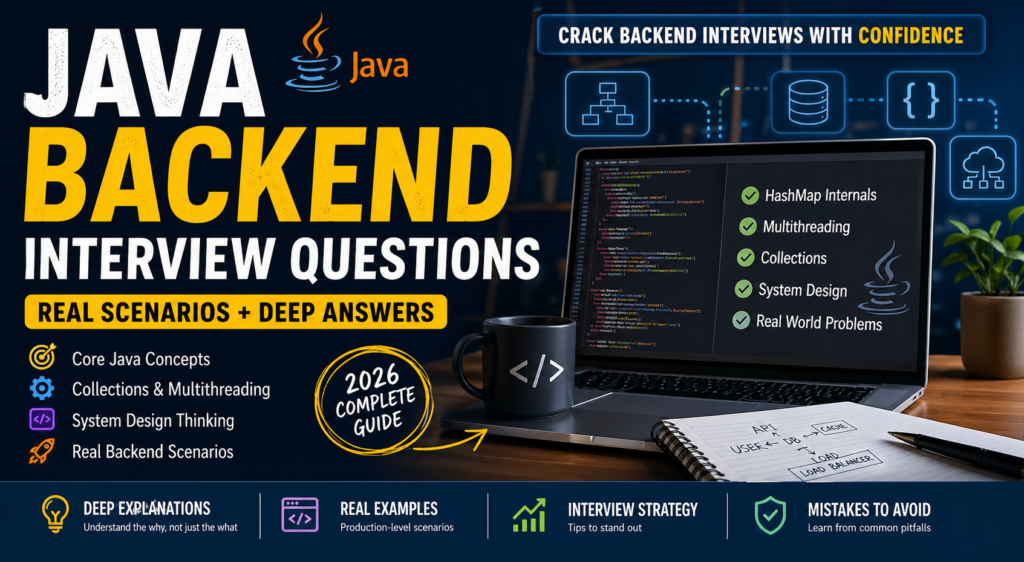
Java Backend Interview Questions
Real Scenarios That Actually Get Asked
Most candidates memorize Java answers. Top candidates think like backend engineers under production pressure.
What this guide fixes:
Shallow answers → Deep reasoning
Theory → Real system thinking
Memory → Problem solving approach
Shallow answers → Deep reasoning
Theory → Real system thinking
Memory → Problem solving approach
🧠 What Interviewers Are Really Testing
- Can you debug production issues?
- Do you understand performance impact?
- Can you explain trade-offs?
- Do you think beyond syntax?
⚡ Core Java Interview Questions (Deep Understanding)
Most Asked
1. HashMap — Why it breaks in production systems?
Most candidates answer: “It stores key-value pairs” ❌
Real engineering answer:
HashMap internally is not just a structure—it is a hash-based indexing system:
- Key → hashCode() → bucket index
- Buckets store entries
- Collision handling:
- LinkedList (Java 7)
- Tree (Java 8 optimization)
Real-world failure case:
Bad hash function → uneven distribution → system slowdown → O(n) performance
Bad hash function → uneven distribution → system slowdown → O(n) performance
2. Why ConcurrentHashMap exists?
HashMap fails in multi-threaded environments because:
- Concurrent writes corrupt structure
- Resize causes race conditions
Evolution:
Java 7 → Segment locking (coarse concurrency)
Java 8 → CAS + fine-grained locking (better performance)
Java 8 → CAS + fine-grained locking (better performance)
3. Why String is immutable?
Because Java uses String in:
- Security layers (URLs, DB connections)
- Shared memory (String pool)
- Multi-threaded environments
If mutable → shared strings could be modified accidentally → security breach risk
📦 Collections Interview Thinking
ArrayList vs LinkedList (REAL decision logic)
ArrayList → optimized for READ operations
LinkedList → optimized for INSERT/DELETE operations
LinkedList → optimized for INSERT/DELETE operations
Mistake: answering only complexity without use-case
🔥 Multithreading (Where Most Candidates Fail)
Race Condition Explained Like a Backend Engineer
Two threads updating same variable → final state depends on timing → unpredictable output
Real fix strategies:
- synchronized (blocking)
- Locks (controlled access)
- Atomic operations (best performance)
Deadlock (Production Nightmare)
Thread A waits for B
Thread B waits for A
→ system freeze
Most systems crash not due to bugs—but due to improper locking order
🚀 Real Backend Scenarios (Differentiator Section)
Slow API Debugging Flow
Step 1: Database query analysis
Step 2: Logging inspection
Step 3: Thread dump analysis
Step 4: CPU/memory profiling
Reality: 80% of slow APIs are DB bottlenecks, not Java code issues
High Throughput System Design Thinking
Core tools:
- Redis caching
- Kafka queues
- Load balancing
Trade-off always exists:
Consistency vs Performance
🧩 System Design Interview Core Ideas
Design:
- Rate limiter
- Notification system
- Logging system
Always explain:
Scalability + Fault tolerance + Data consistency
❌ Why Most Candidates Fail
- Memorized answers
- No system thinking
- Weak follow-up handling
Winning strategy: Think like a production engineer, not a student