
AI Hackathon Bangalore

At first glance, the AI for Bharat Hackathon looks like just another opportunity with prize money and exposure. But if you read the problem statements closely, you’ll realize something most participants miss—this is less about building AI models and more about solving system-level chaos that even governments struggle with. The difference between average and winning teams won’t be coding skills alone, but how well they handle ambiguity, incomplete data, and real-world constraints. In this breakdown, you’ll understand where most teams go wrong, what actually gives you an edge, and how to approach this hackathon like a serious problem-solver—not just a participant.
AI for Bharat Hackathon Overview
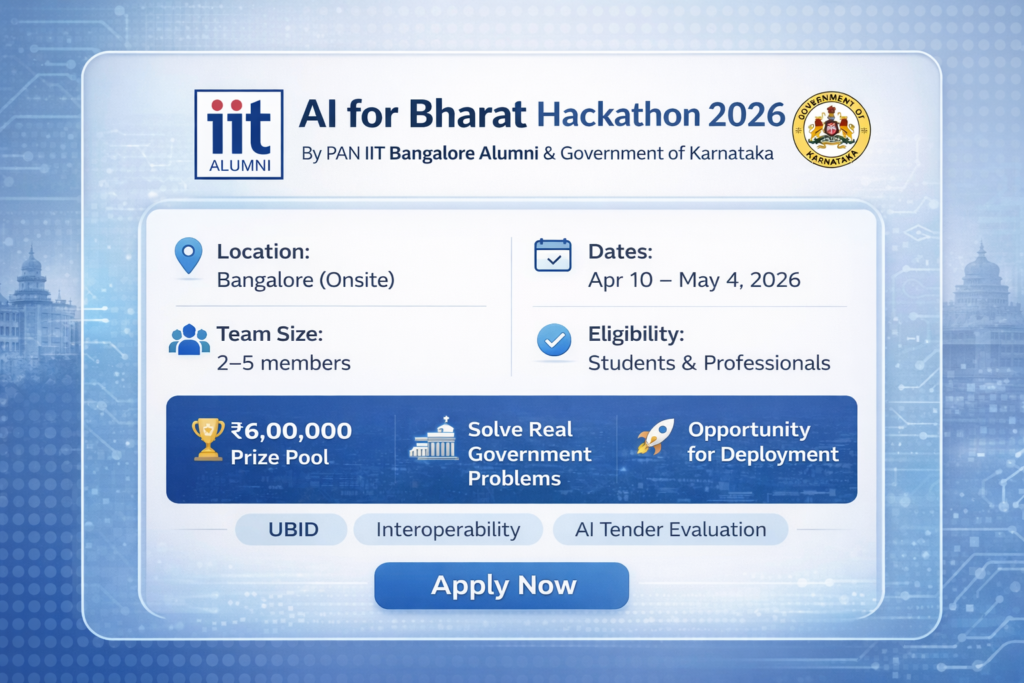
Why This Hackathon Actually Matters
| What Most Hackathons Do | What Happens Here |
|---|---|
| Focus on quick demos and UI | Focus on systems that can work in real environments |
| Accept black-box AI outputs | Require explainable, auditable decisions |
| Use clean, structured datasets | Deal with messy, inconsistent real-world data |
| Reward flashy ideas | Reward feasibility and long-term impact |
| Ignore deployment constraints | Evaluate based on real government usability |
What This Means for You
This hackathon changes the way you should think about building solutions. Instead of optimizing for speed or presentation, you need to design for reliability, traceability, and real-world constraints. The problems are intentionally complex—not because they are technical puzzles, but because they reflect how fragmented and unpredictable real systems can be.
Key Themes & Problem Statements
This hackathon is not about building random AI models. Each theme targets a real system-level problem where data, workflows, and decisions are deeply interconnected.
🔗 Unified Business Identifier (UBID)
The Real Problem: Businesses exist across multiple government systems with no common identity, making tracking and analysis unreliable.
What You Need to Solve: Link fragmented records into a single identity using partial, inconsistent data.
Skills Tested: Data matching, entity resolution, confidence scoring, explainability.
💡 Insight: This is less about AI models and more about handling messy real-world data.
🔄 System Interoperability
The Real Problem: Government systems operate in silos, and updates in one system don’t reflect in others.
What You Need to Solve: Build a reliable two-way sync layer without modifying existing systems.
Skills Tested: API design, event-driven architecture, conflict resolution, idempotency.
💡 Insight: This is a system design challenge disguised as a coding problem.
📄 AI-Based Tender Evaluation
The Real Problem: Evaluating tender documents manually is slow, inconsistent, and error-prone.
What You Need to Solve: Extract, analyze, and validate eligibility criteria from unstructured documents.
Skills Tested: NLP, OCR, document parsing, explainable AI.
💡 Insight: Accuracy alone is not enough—your system must justify every decision.
Who Should Join This Hackathon
This is not a one-skill hackathon. Your chances depend less on titles and more on how you think about solving real-world system problems. Here’s how different profiles fit in.
⚙️ Backend & System Engineers
Why you fit: Most challenges involve system integration, data flow, and reliability.
Where you add value: Designing APIs, handling event-driven systems, ensuring consistency.
💡 Edge: Strong advantage in interoperability theme.
🧠 Data & ML Engineers
Why you fit: Problems require extracting insights from unstructured and inconsistent data.
Where you add value: Entity resolution, NLP, document analysis, classification.
💡 Edge: Critical for tender evaluation and UBID themes.
💻 Full Stack Developers
Why you fit: Every solution needs a usable interface for reviewers and stakeholders.
Where you add value: Building dashboards, review workflows, and user-facing tools.
💡 Edge: Important for demo quality and usability scoring.
📊 Problem Solvers & Analysts
Why you fit: Understanding the problem deeply matters more than writing code.
Where you add value: Defining logic, handling edge cases, improving decision clarity.
💡 Edge: Helps teams avoid over-engineering and focus on real impact.
Skills That Give You an Edge
This hackathon rewards practical problem-solving over theoretical knowledge. The following skills are not just “nice to have”—they directly influence how strong your solution will be.
| Skill Area | Where It Applies | Why It Matters | Your Advantage |
|---|---|---|---|
| Entity Resolution | UBID Theme | Helps link the same business across fragmented datasets | Enables high-confidence matching with fewer errors |
| System Design | Interoperability Theme | Required for handling real-time updates and system integration | Build scalable and reliable architecture |
| NLP & Document Parsing | Tender Evaluation | Extracts structured data from unstructured documents | Improves automation accuracy in evaluation |
| Explainable AI | All Themes | Decisions must be transparent and auditable | Increases trust and evaluation score |
| Event-Driven Architecture | System Sync Problems | Handles updates across multiple systems reliably | Prevents data inconsistency and duplication |
| Data Cleaning & Handling | All Themes | Real-world data is incomplete and inconsistent | Reduces errors and improves model output |
Real Judging Criteria Breakdown
| Criteria | Weight | What Actually Matters |
|---|---|---|
| Problem Understanding | 20% | Clear grasp of real-world constraints |
| Technical Implementation | 25% | Working solution, not just concept |
| Feasibility | 25% | Can it realistically work in government systems? |
| Demo & Presentation | 15% | Clarity, not complexity |
| Scalability & Impact | 15% | Long-term usability matters more than features |
What Winning Teams Do Differently
The gap between average and top teams is not effort—it’s approach. Most participants build for demos. Winning teams build for reality.
❌ Common Approach
- Focus on building complex AI models
- Ignore messy or missing data
- Rely heavily on pre-built tools without control
- Design only for demo, not real usage
- Skip explainability and decision tracking
✅ Winning Approach
- Start with problem clarity, not model selection
- Handle incomplete and inconsistent data explicitly
- Build controlled, explainable pipelines
- Design for real workflows and user interaction
- Make every decision traceable and auditable
🧠 They Solve Systems, Not Just Tasks
Winning teams don’t treat problems as isolated features. They understand how data flows, where failures can occur, and how decisions impact downstream systems.
⚙️ They Design for Constraints
Instead of assuming perfect data or APIs, they plan for limitations—missing fields, inconsistent formats, and integration challenges.
🔍 They Prioritize Explainability
A correct answer is not enough. Winning solutions show why a decision was made, what data was used, and how confident the system is.
Submission Requirements Explained
- Idea Submission A clear write-up of your solution approach (problem understanding + how you plan to solve it)
- Working Prototype / Demo A functional version of your solution (basic but should actually work)
- 5-Minute Video Walkthrough Short explanation covering problem, solution, and demo (keep it clear and structured)
- Code Repository (GitHub/GitLab) Well-organized code with proper README explaining setup and usage
Prize Details & Career Impact
While the prize pool is attractive, the real value of this hackathon goes beyond cash rewards. It’s an opportunity to gain visibility, validate ideas, and work on problems that have real-world relevance.
🏆 Grand Winner
₹3,00,000
Top-performing team across all themes
🥇 Theme Winners
₹1,00,000 each
Best solution in each problem category
🚀 Special Opportunity
Beyond Cash
Selected solutions may get pilot opportunities and sandbox access
📈 What You Gain Beyond Prizes
- Real-World Experience: Work on problems that reflect actual government challenges, not simulated datasets.
- Stronger Portfolio: Build a project that stands out in interviews due to its complexity and relevance.
- Industry Exposure: Present your solution to experts, policymakers, and potential investors.
- Networking Advantage: Connect with mentors, teams, and professionals from diverse domains.
FAQs for Participants
Yes—but only if you focus on problem understanding rather than complex implementations. Beginners who contribute in research, logic design, or UI can still add strong value to a team.
Not necessarily. While AI is part of the themes, system design, backend development, and data handling are equally important. Teams with mixed skills often perform better than purely AI-focused teams.
The initial phases are online, but the final stage is conducted onsite in Bangalore. Shortlisted teams are expected to be physically present for the final round.
Solutions that are practical, explainable, and feasible in real-world conditions have a higher chance. Overly complex ideas without clarity or usability are usually filtered out early.
Treating it like a regular hackathon. Many teams focus only on building features instead of solving the core problem clearly. Lack of explainability and poor handling of edge cases often leads to rejection.
Step-by-Step Application Guide
Follow these simple steps to complete your registration and avoid common mistakes that can delay your submission.
-
Register on the Platform
Use the official registration link to create your profile and access the hackathon dashboard. -
Form or Join a Team
Ensure your team has 2–5 members with complementary skills (development + problem-solving + AI). -
Select the Right Theme
Choose a problem statement that matches your team’s strengths instead of picking randomly. -
Prepare Your Idea Submission
Clearly explain your approach, logic, and how your solution handles real-world constraints. -
Submit Before Deadline
Double-check all required fields and ensure your submission is complete and clear.