
Optum AI/ML Engineer Job 2026
Let me tell you something they don’t usually put in a job description: most days, as an AI/ML engineer, you’re staring at data that doesn’t want to behave, debugging a model that’s being stubborn, and wondering if any of it actually matters. But then — just once in a while — you build something that quietly, invisibly, helps someone avoid a hospital visit they didn’t need. And suddenly, all those late nights make sense. That’s the kind of work we’re talking about today.
Inside UnitedHealth Group: Optum’s AI Vision

Optum’s AI vision is simple: help humans, not replace them.
While many tech companies chase flashy automation, Optum focuses on the quiet work — building models that support doctors, reduce errors, and make healthcare less exhausting for everyone.
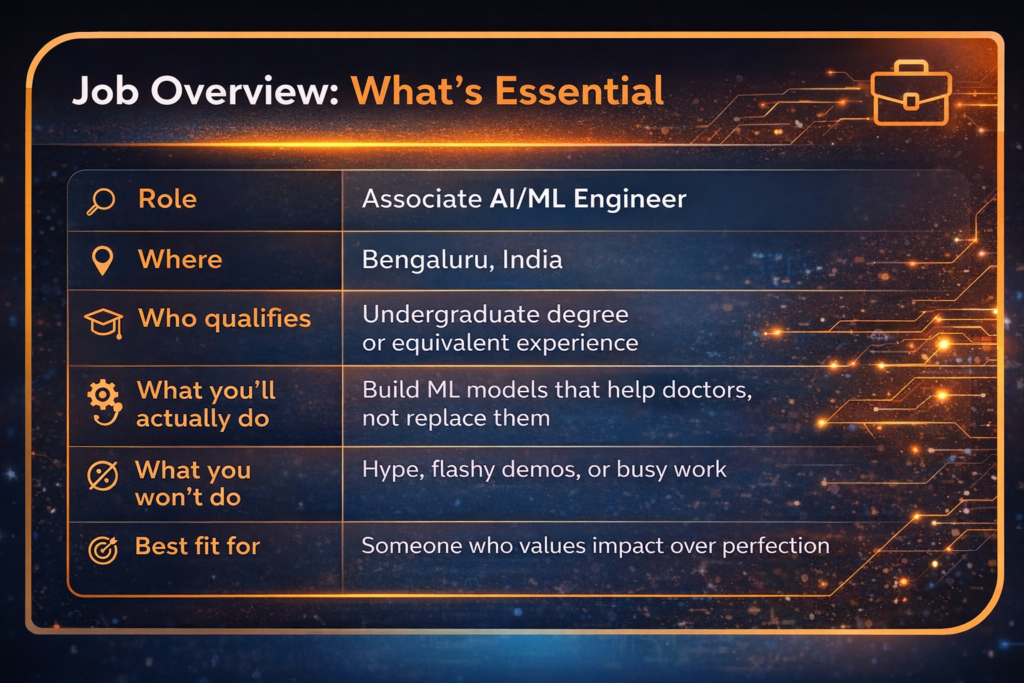
As an Associate AI/ML Engineer in Bengaluru, you won’t be building sci-fi robots. You’ll be solving real, messy problems with real-world data. No perfection. No hype. Just honest work that makes the health system work better — one small improvement at a time.
Optum AI/ML Engineer : Job Overview
Core Skills & Eligibility Optum Expects
What Optum Actually Expects (The Non-Negotiables)
| Area | What That Means in Plain English |
|---|---|
| Education | A bachelor’s degree — or if you don’t have one, real-world experience that proves you can code |
| ML Knowledge | You understand supervised learning. You’ve trained at least one model that didn’t embarrass you. |
| Programming | Python is your comfort zone. Pandas, scikit-learn, maybe some TensorFlow or PyTorch. |
| Data handling | You’re not afraid of messy CSV files. SQL doesn’t scare you. |
| Collaboration | You can explain a model to someone who doesn’t know what a tensor is. |
What They Value (But Won’t Always List)
| Quality | Why It Matters at Optum |
|---|---|
| Curiosity about healthcare | You don’t need a medical degree — but you should care why a prediction matters |
| Patience with ambiguity | Healthcare data is never clean. Never. |
| Low ego | The best idea wins. Not the loudest voice. |
| Honest communication | Saying “I don’t know yet” is respected here |
| Bias awareness | You think about whether your model could hurt someone unintentionally |
What You’ll Actually Work On as an AI/ML Engineer
⚙️ What You’ll Actually Work On
4 real responsibilities — no buzzwords
Wrangle messy data
Claims, clinical notes, pharmacy logs — clean what Kaggle never shows you.
Build practical models
Logistic regression, XGBoost — simple models that actually ship.
Translate for humans
Explain ML to clinicians & product folks. No ego.
Ship & monitor
Deploy, track drift, fix what breaks. End-to-end ownership.
Optum Hiring Process 2026
📋 Optum Hiring Process 2026
Associate AI/ML Engineer — Bengaluru | Round-by-round breakdown
✅ Drug test required before joining (standard for UnitedHealth Group).
Optum AI/ML Engineer Salary in India: Real Range
💰 Optum AI/ML Engineer Salary
Associate Level | Bengaluru, India | 2026 Realistic Range
| Component | Annual Range (INR) |
|---|---|
| Base Salary | ₹8,00,000 – ₹14,00,000 |
| Performance Bonus | ₹80,000 – ₹1,50,000 |
| Total Compensation (Base + Bonus) | ₹8,80,000 – ₹15,50,000 |
| Stock Options / RSUs | Not typical at Associate level |
| Other Perks | Health insurance, wellness programs, learning budget |
Why This AI/ML Role Is Harder Than It Looks
Myth vs. Reality
Myth #1: “I’ll build cutting-edge LLMs every day.”
Reality: You’ll spend Tuesdays wrestling a CSV file from 2018 where someone typed “N/A”, “NA”, “null”, and “-” — all meaning the same thing. The fancy models come later. The boring data cleanup comes now.
Myth #2: “My code will speak for itself.”
Reality: No one reads your beautiful code. They ask you to explain it in a meeting with a doctor who has 7 minutes between patients. If you can’t simplify it, your work doesn’t exist.
Myth #3: “I’ll get recognized for my smart solutions.”
Reality: Your biggest win might be reducing a false alert rate by 3%. No one throws a party. But somewhere, a nurse didn’t get paged at 2 AM for nothing. That’s your applause.
Myth #4: “I just need to be technically strong.”
Reality: Your hardest conversation won’t be about transformers or attention mechanisms. It’ll be about fairness. “Could this model accidentally hurt someone?” Answering that honestly is harder than any LeetCode problem.
Myth #5: “Healthcare AI is just like any other AI job.”
Reality: Deadlines are different here. A bug in your model could affect insurance, treatment, or access. The pressure isn’t about shipping fast — it’s about shipping right. That weight is real.
Top Reasons Candidates Get Rejected at Optum
- 🧠 Couldn’t explain ML to a non-tech person — Jargon without clarity = rejection.
- 🏥 No curiosity about healthcare — They don’t need another generic AI engineer.
- 🎭 Overhyped projects with no depth — “Built a ChatGPT clone” tells them nothing real.
- ⚖️ Failed the ethics check — Didn’t think about bias or harm in models.
- 🧹 Weak data cleaning skills — Fumbled pandas/SQL basics in the assessment.
- 🔄 Couldn’t take feedback — Got defensive when interviewers challenged their approach.
- 👥 No real collaboration examples — “I did everything alone” isn’t a flex here.
- 💊 Underestimated the drug test — Yes, it’s mandatory. Yes, they check.
Optum AI/ML Engineer Role: FAQs Answered
1. Do I need a healthcare background?
No. Just curiosity. Read one article about healthcare AI before the interview.
2. Is LeetCode required?
Not really. Focus on pandas, SQL, and data cleaning. No binary trees on whiteboards.
3. What’s the culture like for freshers?
Supportive but no hand-holding. Saying “I don’t know yet” is respected. Faking it isn’t.
4. Can I work remotely?
Based in Bengaluru. Hybrid possible. Fully remote? Unlikely for entry-level.
5. How long is the hiring process?
2 to 4 weeks typically. Drug test comes after the offer, not before.