
Skillz Backend Engineer Role:

If you’re reading this, there’s a good chance you spend your days thinking about databases, APIs, and how to make things run faster. (No judgment—we do too.) And if you’ve ever secretly smiled when a tricky piece of code finally worked? Yeah, you’re in the right place.
What is Skillz Inc.? Company Overview

- What we do: We make mobile gaming competitive.
- How we do it: By giving developers tools to add tournaments, prizes, and real-money play to their games.
- Why it matters: Because competition is fun, and we believe anyone with skill should have a shot at winning.
Backend Engineer Job Overview – Skillz Bengaluru
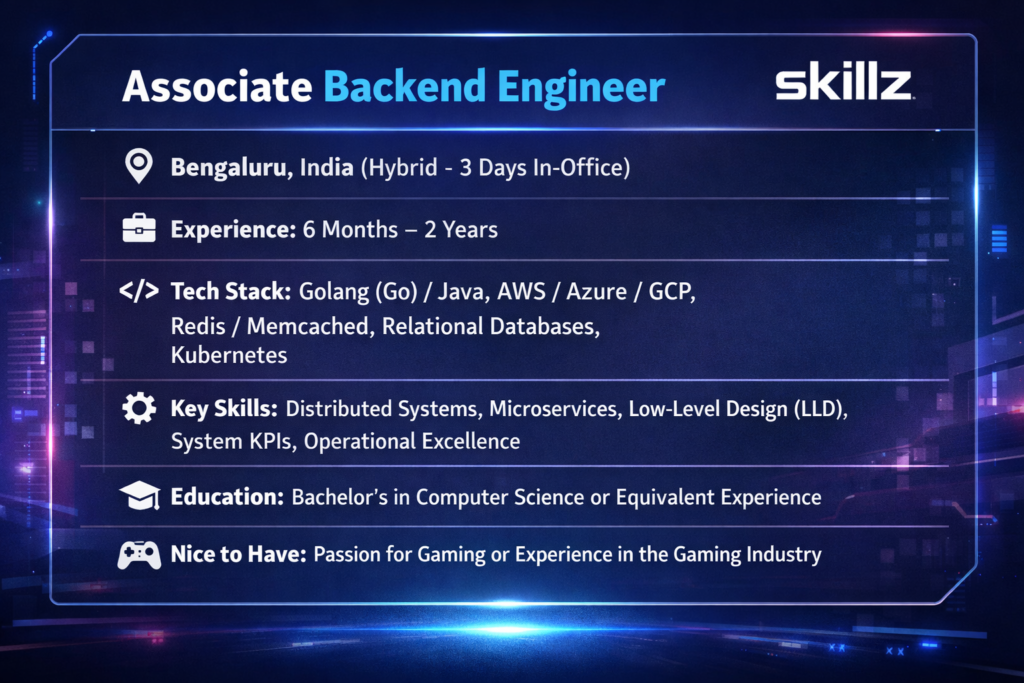
Backend Engineer Eligibility & Skills Required
Eligibility Criteria
| Criteria | Requirement |
|---|---|
| Experience | 6 months – 2 years |
| Education | Bachelor’s in Computer Science or equivalent |
| Work Mode | In-office 3 days a week (Bengaluru) |
| Industry | Gaming experience preferred, not mandatory |
Skills Required
| Skill Area | What You Need |
|---|---|
| Languages | Golang (Go) OR Java |
| Core CS | Data structures, algorithms, OOP, complexity analysis |
| Distributed Systems | Multi-tiered systems, caching (Redis/Memcached), relational databases |
| Cloud | AWS, Azure, or GCP |
| Microservices | Building new services or enhancing existing ones |
| System Design | Low-level design (LLD) from requirements |
| Operations | System KPIs, SLAs, reliability improvements |
| Communication | Clear technical articulation across teams |
Backend Engineer Roles and Responsibilities at Skillz
What You’ll Do Day-to-Day
| 🚀 | Build & Scale — Create backend systems that power millions of tournaments |
| 💻 | Write Code — Ship clean, scalable code in Go or Java |
| 📐 | Design Systems — Turn ideas into precise low-level designs (LLD) |
| 🔧 | Build Microservices — Create new services and improve existing ones |
| 🗄️ | Handle Data — Work with Redis, Memcached, and relational databases |
| ☁️ | Deploy on Cloud — Use AWS, Azure, or GCP like a pro |
| 📊 | Keep Things Fast — Improve system KPIs, SLAs, and reliability |
| 🤝 | Collaborate — Work with product, frontend, and QA teams |
| 🎙️ | Share Ideas — Explain technical stuff clearly to anyone |
Skillz Backend Engineer Hiring Process
Simple. Transparent. Human.
Application Review — We review your resume. If it’s a match, we reach out within 5–7 days.
Recruiter Screening — A 30-min friendly chat. We get to know you. You get to know us.
Technical Assessment — A practical coding exercise in Go or Java. No tricks. Just real problem-solving.
Technical Interviews — 2–3 rounds covering system design, distributed systems, and how you think.
Leadership & Culture Fit — A conversation about your growth, values, and what makes you tick.
Offer & Onboarding — Welcome to the team! We’ll help you settle in and start making impact from day one.
Skillz Backend Engineer Salary & Benefits
Compensation
| Component | Details |
|---|---|
| Base Salary | Competitive, based on experience |
| Bonus | Annual performance bonus |
| Equity | Stock options – share in Skillz success |
Perks
| Benefit | Details |
|---|---|
| Health Insurance | Coverage for you and dependents |
| Tax Savings | FBP for fuel, internet, phone bills |
| Retirement | National Pension System (NPS) |
| Work Mode | Hybrid – 3 days in-office |
| Growth | Mentorship from top tech experts |
5 Mistakes to Avoid – Backend Engineer Role at Skillz
🚫 Listing languages you barely know — Show real Go or Java experience.
⚡ Ignoring scale stories — Mention Redis, Memcached, or performance wins.
💤 Applying like any other job — Tell us why Skillz excites you.
🌀 Skipping system thinking — Practice low-level design basics.
🔧 Only hyping new features — Share how you kept systems reliable.
⚡ Skillz Backend Engineer | Coding Interview Questions
Golang • Java • Distributed Systems • Concurrency • System Design • Real-World Problems
📖 Problem
Design a rate limiter that allows at most N requests per second per user. Implement the allowRequest(userId) method. This tests your understanding of caching, concurrency, and distributed systems.
📤 Output: First 3 requests return true, 4th request within same second returns false
☕ Java Code — Token Bucket
import java.util.concurrent.ConcurrentHashMap;
import java.util.concurrent.atomic.AtomicLong;

public class RateLimiter {
    private final int maxRequests;
    private final long windowMs;
    private final ConcurrentHashMap<String, AtomicLong> counterMap = new ConcurrentHashMap<>();

    public RateLimiter(int maxRequests, long windowMs) {
        this.maxRequests = maxRequests;
        this.windowMs = windowMs;
    }

    public boolean allowRequest(String userId) {
        long now = System.currentTimeMillis();
        long windowKey = now / windowMs;
        String key = userId + ":" + windowKey;

        AtomicLong counter = counterMap.computeIfAbsent(key, k -> new AtomicLong(0));

        // Clean up old entries
        if (counterMap.size() > 1000) {
            counterMap.entrySet().removeIf(entry ->
                Long.parseLong(entry.getKey().split(":")[1]) < (now / windowMs) - 2);
        }

        return counter.incrementAndGet() <= maxRequests;
    }

    public static void main(String[] args) throws InterruptedException {
        RateLimiter limiter = new RateLimiter(3, 1000);

        System.out.println(limiter.allowRequest("user1")); // true
        System.out.println(limiter.allowRequest("user1")); // true
        System.out.println(limiter.allowRequest("user1")); // true
        System.out.println(limiter.allowRequest("user1")); // false

        Thread.sleep(1000);
        System.out.println(limiter.allowRequest("user1")); // true (new window)
    }
}📖 Problem
Implement an in-memory cache that supports put(key, value, ttl) and get(key) with automatic expiry. Must be thread-safe — exactly what you'd use with Redis/Memcached.
☕ Java Code — Concurrent Cache
import java.util.concurrent.*;
import java.util.*;

public class TTLCache<K, V> {
    private static class CacheEntry<V> {
        V value;
        long expiryTime;

        CacheEntry(V value, long ttlMs) {
            this.value = value;
            this.expiryTime = System.currentTimeMillis() + ttlMs;
        }

        boolean isExpired() {
            return System.currentTimeMillis() > expiryTime;
        }
    }

    private final ConcurrentHashMap<K, CacheEntry<V>> cache = new ConcurrentHashMap<>();
    private final ScheduledExecutorService cleaner = Executors.newSingleThreadScheduledExecutor();

    public TTLCache() {
        cleaner.scheduleAtFixedRate(this::cleanExpired, 1, 1, TimeUnit.SECONDS);
    }

    public void put(K key, V value, long ttlMs) {
        cache.put(key, new CacheEntry<>(value, ttlMs));
    }

    public V get(K key) {
        CacheEntry<V> entry = cache.get(key);
        if (entry == null || entry.isExpired()) {
            cache.remove(key);
            return null;
        }
        return entry.value;
    }

    private void cleanExpired() {
        cache.entrySet().removeIf(entry -> entry.getValue().isExpired());
    }

    public static void main(String[] args) throws InterruptedException {
        TTLCache<String, String> cache = new TTLCache<>();

        cache.put("tournament", "active", 2000);
        System.out.println(cache.get("tournament")); // active

        Thread.sleep(2500);
        System.out.println(cache.get("tournament")); // null
    }
}📖 Problem
Process 1000 tournament match results using a worker pool of 10 goroutines. This tests your understanding of Go concurrency, channels, and wait groups — essential for high-throughput backend services.
🐹 Golang Code — Worker Pool
package main

import (
    "fmt"
    "sync"
    "time"
)

func worker(id int, jobs <-chan int, results chan<- int, wg *sync.WaitGroup) {
    defer wg.Done()
    for job := range jobs {
        // Simulate processing tournament result
        time.Sleep(10 * time.Millisecond)
        results <- job * 2 // some processing
        fmt.Printf("Worker %d processed job %d\n", id, job)
    }
}

func main() {
    const numJobs = 1000
    const numWorkers = 10

    jobs := make(chan int, numJobs)
    results := make(chan int, numJobs)

    var wg sync.WaitGroup

    // Start workers
    for w := 1; w <= numWorkers; w++ {
        wg.Add(1)
        go worker(w, jobs, results, &wg)
    }

    // Send jobs
    for j := 1; j <= numJobs; j++ {
        jobs <- j
    }
    close(jobs)

    // Wait for all workers to finish
    go func() {
        wg.Wait()
        close(results)
    }()

    // Collect results
    count := 0
    for result := range results {
        count++
        _ = result
    }

    fmt.Printf("Processed %d results\n", count)
}📖 Problem
Design an ATM machine with withdraw, deposit, and balance check functionality. Focus on object-oriented design, encapsulation, and state management — exactly what you'll do when building microservices at Skillz.
☕ Java Code — ATM LLD
import java.util.*;

interface ATMState {
    void insertCard();
    void ejectCard();
    void enterPin(int pin);
    void requestCash(int amount);
}

class ATM {
    private ATMState state;
    private int balance;
    private boolean cardInserted;
    private int enteredPin;

    public ATM(int initialBalance) {
        this.balance = initialBalance;
        this.state = new IdleState(this);
        this.cardInserted = false;
    }

    void setState(ATMState state) { this.state = state; }
    int getBalance() { return balance; }
    void setBalance(int balance) { this.balance = balance; }
    boolean isCardInserted() { return cardInserted; }
    void setCardInserted(boolean inserted) { this.cardInserted = inserted; }
    void setEnteredPin(int pin) { this.enteredPin = pin; }
    int getEnteredPin() { return enteredPin; }

    public void insertCard() { state.insertCard(); }
    public void ejectCard() { state.ejectCard(); }
    public void enterPin(int pin) { state.enterPin(pin); }
    public void requestCash(int amount) { state.requestCash(amount); }
}

class IdleState implements ATMState {
    private ATM atm;

    IdleState(ATM atm) { this.atm = atm; }

    public void insertCard() {
        System.out.println("Card inserted");
        atm.setCardInserted(true);
        atm.setState(new HasCardState(atm));
    }
    public void ejectCard() { System.out.println("No card to eject"); }
    public void enterPin(int pin) { System.out.println("Insert card first"); }
    public void requestCash(int amount) { System.out.println("Insert card first"); }
}

class HasCardState implements ATMState {
    private ATM atm;

    HasCardState(ATM atm) { this.atm = atm; }

    public void insertCard() { System.out.println("Card already inserted"); }
    public void ejectCard() {
        System.out.println("Card ejected");
        atm.setCardInserted(false);
        atm.setState(new IdleState(atm));
    }
    public void enterPin(int pin) {
        if (pin == 1234) {
            System.out.println("PIN correct");
            atm.setState(new AuthenticatedState(atm));
        } else {
            System.out.println("Wrong PIN");
            ejectCard();
        }
    }
    public void requestCash(int amount) { System.out.println("Enter PIN first"); }
}

class AuthenticatedState implements ATMState {
    private ATM atm;

    AuthenticatedState(ATM atm) { this.atm = atm; }

    public void insertCard() { System.out.println("Card already inserted"); }
    public void ejectCard() {
        System.out.println("Card ejected");
        atm.setCardInserted(false);
        atm.setState(new IdleState(atm));
    }
    public void enterPin(int pin) { System.out.println("PIN already entered"); }
    public void requestCash(int amount) {
        if (amount <= atm.getBalance()) {
            atm.setBalance(atm.getBalance() - amount);
            System.out.println("Withdrawn: " + amount + ", Remaining: " + atm.getBalance());
            ejectCard();
        } else {
            System.out.println("Insufficient balance");
            ejectCard();
        }
    }
}

public class ATMMachine {
    public static void main(String[] args) {
        ATM atm = new ATM(2000);
        atm.insertCard();
        atm.enterPin(1234);
        atm.requestCash(500);
    }
}📖 Problem
Design a distributed counter that safely increments across multiple threads/nodes. At Skillz, you'll handle millions of concurrent tournament score updates — this tests your understanding of atomic operations and consistency.
☕ Java Code — Atomic Counter
import java.util.concurrent.atomic.AtomicLong;
import java.util.concurrent.*;
import java.util.*;

public class DistributedCounter {
    private final AtomicLong counter = new AtomicLong(0);

    public long increment() {
        return counter.incrementAndGet();
    }

    public long get() {
        return counter.get();
    }

    public static void main(String[] args) throws InterruptedException {
        DistributedCounter counter = new DistributedCounter();
        int numThreads = 100;
        int incrementsPerThread = 1000;

        ExecutorService executor = Executors.newFixedThreadPool(numThreads);
        CountDownLatch latch = new CountDownLatch(numThreads);

        for (int i = 0; i < numThreads; i++) {
            executor.submit(() -> {
                for (int j = 0; j < incrementsPerThread; j++) {
                    counter.increment();
                }
                latch.countDown();
            });
        }

        latch.await();
        executor.shutdown();

        System.out.println("Final counter: " + counter.get());
        System.out.println("Expected: " + (numThreads * incrementsPerThread));
    }
}Backend Engineer Role Skillz - FAQs
- Need gaming experience?
No. Backend skills matter more. - Remote or in-office?
Hybrid – 3 days a week in Bengaluru. - Know Java but not Go?
Yes, apply. Openness to learn Go is key. - What's in the technical interview?
LLD, system design, data structures, and coding in Go/Java. - Response time?
5–7 business days after applying.
How To Apply for Skillz Backend Engineer
Ready to Level Up Your Career?
Join Skillz Bengaluru and build the future of mobile eSports
📍 Location: Skillz, Table Space Towers, Krishnarajapuram, Bengaluru
Final Pro Tip
Don't just tell us what you've done — show us how you think. When you write your application or walk into the interview, share the *why* behind your decisions. That's what sets great engineers apart.